
[Webinar] Can you prove AI is working? (Sponsored)
AI is in your engineering workflow. While the token spend shows it, the throughput doesn’t. The human is very much still in the loop, and that’s a context problem. Join live on Aug 19 (FREE) to learn:
The most capable AI models are also the most expensive to run. They need specialized hardware, they consume large amounts of memory, and they add cost and delay to every request they handle. These traits make them hard to deploy in places where resources are limited, such as a mobile device or a service that handles heavy traffic and needs fast and low-cost responses. There is also a second fact that sounds backward at first. A small model can sometimes match or beat a much larger model on a specific task, even when the small model learned everything it knows from the larger one. On an intuitive level, a model trained on another model’s output would seem to inherit a ceiling rather than break through it, yet the results are different. The method that makes this work is called knowledge distillation, and it has become a standard part of how production AI systems get built. In this article, we will walk through the idea from the ground up. The main points we will cover are as follows:
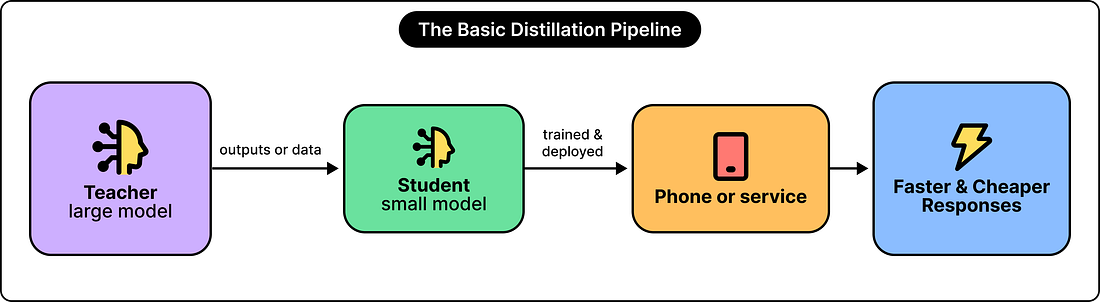
DistillationDistillation trains a new, smaller model to copy the behavior of a larger one. The setup involves two models:
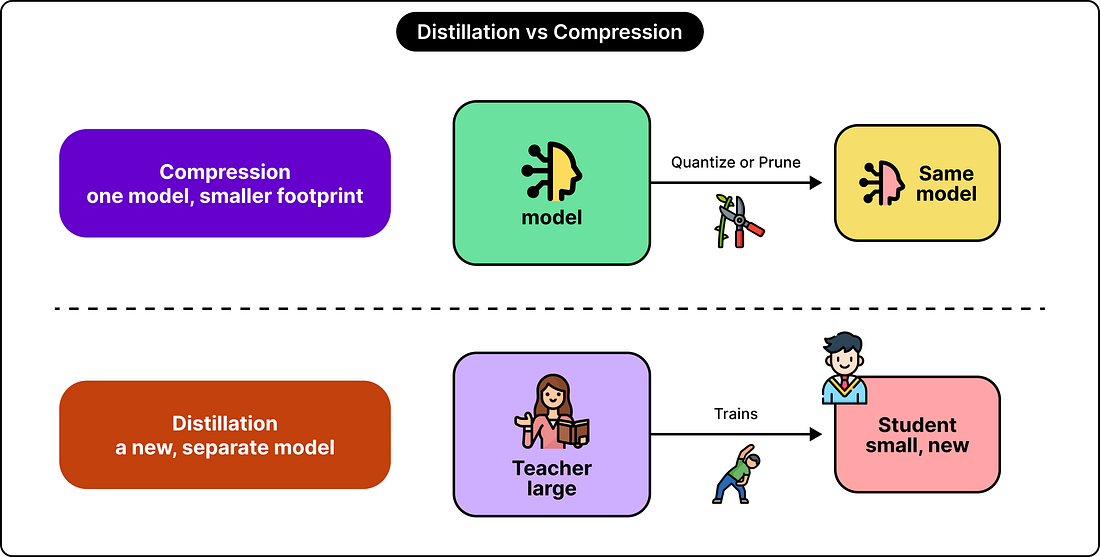
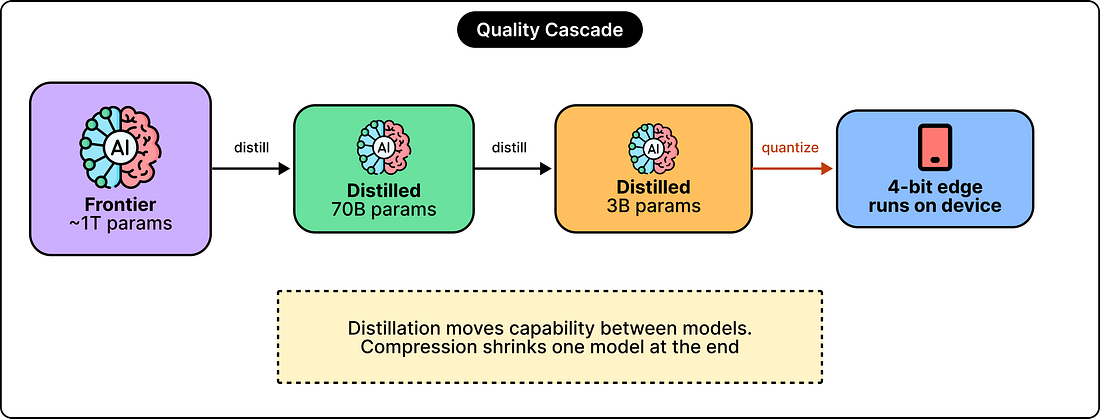
Once training finishes, the student runs on its own, and the teacher steps out of the picture. A common assumption is that the student is the teacher in compressed form. The reality, however, is different. Compression methods such as quantization and pruning start with one model and reduce its footprint by storing its numbers at lower precision or removing parts that contribute little to the result. The model stays the same model, smaller and lighter. Distillation, on the other hand, produces a genuinely separate model, with its own parameters and often a different design, whose goal during training is to behave like the teacher. One operation shrinks an existing model. The other trains a fresh one. The payoff is practical, since a small student can run inside a single service or on a phone, respond in less time, and cost far less for each request, and in some cases, it can run on the device itself without sending data elsewhere.
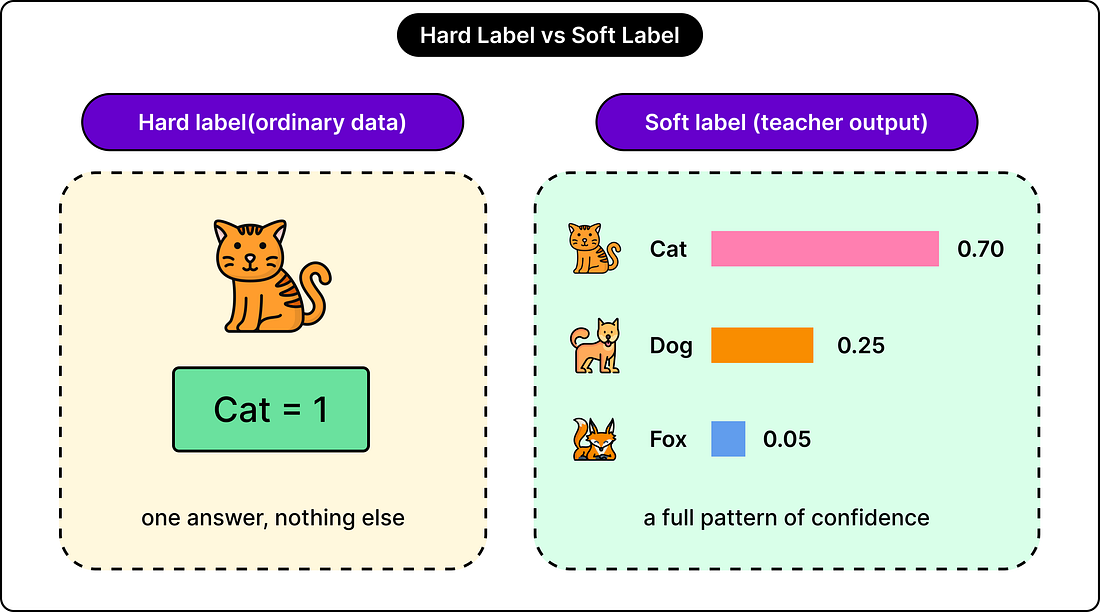
This method is now standard practice. For example, Google’s Gemma models are built using distillation during training, drawing on a larger model in the Gemini family. The two ideas also work together in sequence. A model is often distilled first to produce a smaller capable model, then quantized to shrink that model further for a specific device. Keeping the distinction clear matters because it affects how we understand further concepts. A compressed model carries a copy of the original inside it. A distilled model is a separate thing that was trained to act like the original, which is exactly why it can sometimes behave in ways the original would not. If the student only copies the teacher, why does copying work so well? The answer is in what the teacher hands over. Soft LabelsLearning from a model’s output beats learning from raw data because the output carries more information than a plain answer. Standard training data gives one answer per example. An image of a cat carries the label “cat,” and the model is rewarded for producing “cat” and penalized for anything else. A teacher model offers something richer. Instead of a single answer, its output is a set of probabilities across the options, such as cat at 0.70, dog at 0.25, and fox at 0.05. That full set of probabilities is called a soft label, in contrast to the single hard label found in ordinary data. The extra numbers carry additional information. They show that the teacher’s output ranks dog as a plausible alternative and fox as a distant one, which says something about how the categories relate to each other. Researchers sometimes call this dark knowledge, meaning the structure hidden in a model’s confidence that a bare label leaves out.
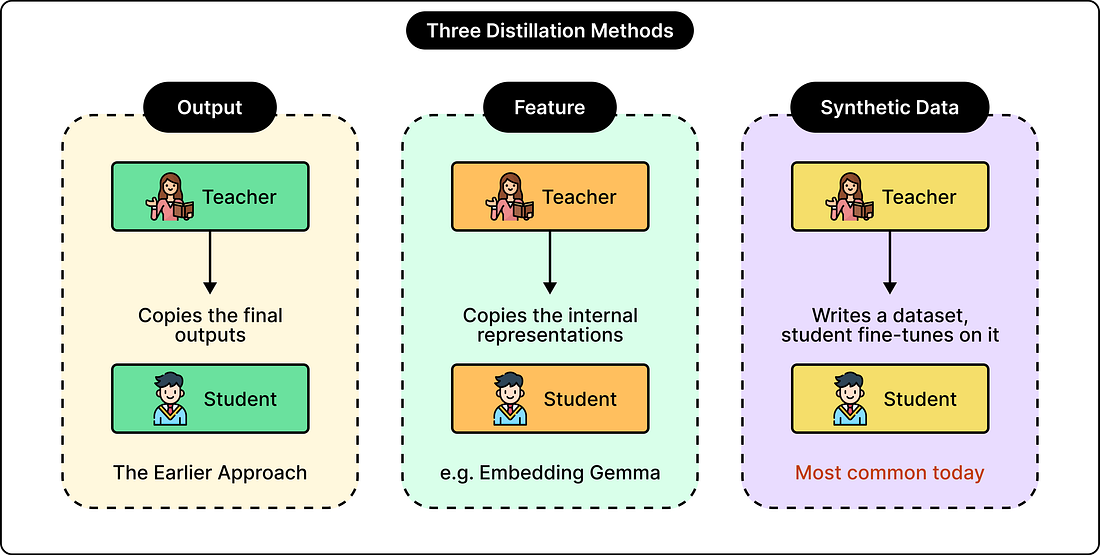
During training, the student works to match this distribution. It is scored on how far its own probabilities sit from the teacher’s, and training pushes it to close that gap. In other words, the student learns the teacher’s whole pattern of confidence rather than a single right answer, and that pattern is a stronger training signal than a one-word label. This is the core reason distillation works as well as it does. A single correct label discards the relationships between options, and soft labels keep them. An early result showed the practical payoff, since a student could reach good performance from far fewer examples when trained on soft targets, because each example now carried more than a single answer. The original 2015 work added a control called temperature for exactly this purpose, where a higher temperature spreads the probabilities out and exposes more of that fine structure for the student to learn. With the mechanism clear, the next question is how this gets done in practice, which has more than one answer. MethodsDistillation comes in three main forms, and they differ in what the student copies:
The third form has become the most common approach in practice, and part of the reason comes down to access. Many strong models are reachable only through an interface that returns text, with their internal values and probabilities kept private. When those internals are out of reach, generating data is the route that still works. The three forms also differ in what they require. Output distillation needs the teacher’s probabilities, feature distillation needs access to its internal values, and synthetic data distillation needs only the text the teacher produces, which is why it travels the furthest across closed models. These methods can also be combined. A single training run might use a generated dataset alongside soft labels, and newer methods mix teacher and student generation during training. These methods are not only theoretical. The next section shows what they produce. ResultsThe results in practice are strong, with one important qualifier. A clear example came in early 2025 from a lab called DeepSeek. It used a large reasoning model to generate a set of training examples, then fine-tuned several existing smaller models on those examples. One result stood out. A 7-billion-parameter student scored higher than a 32-billion-parameter model on a competition mathematics benchmark, even though it was produced by plain fine-tuning on the larger model’s outputs. The released family of distilled models ran from 1.5 billion parameters up to 70 billion, and the smaller ones were compact enough to run on a single graphics card, which is part of why the release drew so much attention. The practical effect was that strong performance on these narrow tasks became something a small team could run locally and cheaply, rather than only through a large hosted model. The qualifier matters as much as the headline. These wins tend to appear on narrow, well-defined tasks such as mathematics and code. On those tasks, a small distilled model can perform at a level its size would not suggest. Across broader measures of general knowledge, the same small models still trail the larger ones. For example, a model can become excellent at competition mathematics through distillation while remaining weaker at wide-ranging questions about the world. Therefore, a claim that a small model beats a large one is usually true in a specific, narrow sense.
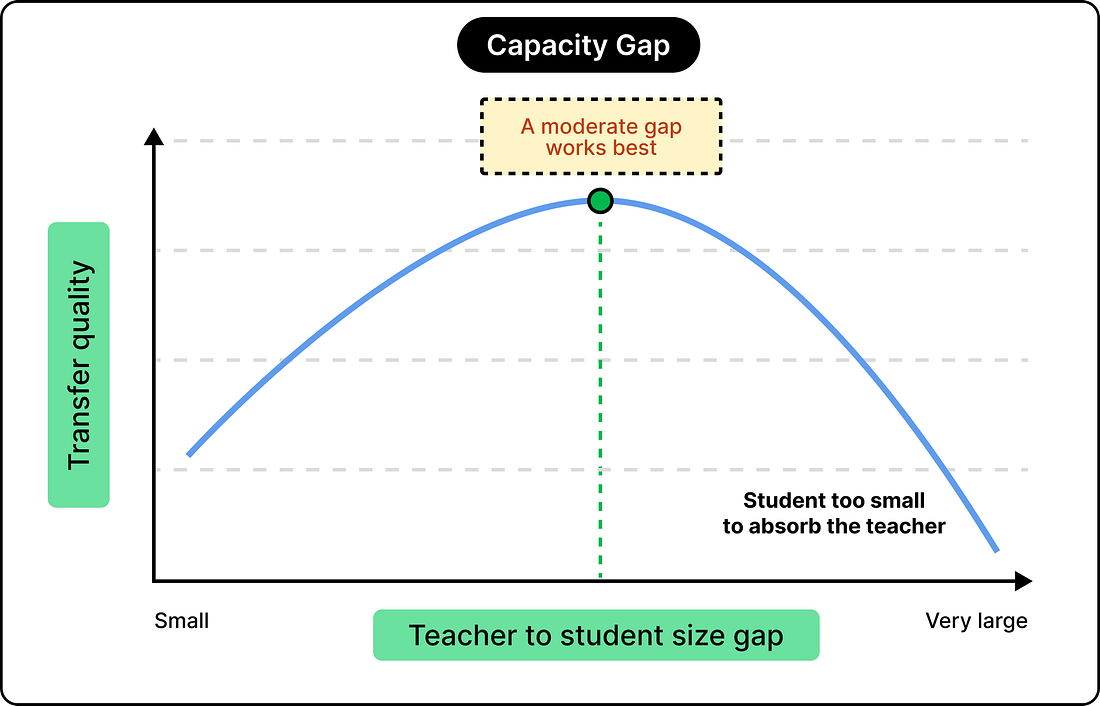
If the results are this good, the natural question is where the method falls short, which the next section takes on directly. LimitsDistillation has clear limits, and they matter when deciding whether it fits a given problem.
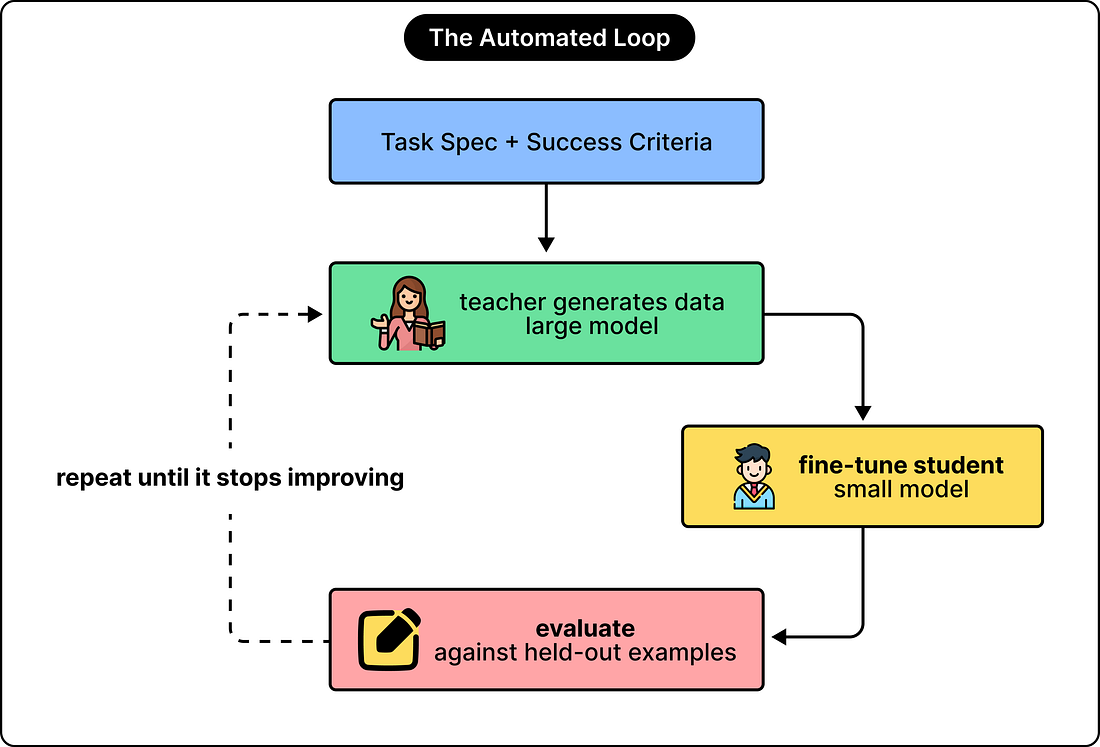
These limits set the boundaries, and within them, the method keeps advancing. The next section covers where it is heading. AutomationThe newest direction in distillation reduces the manual effort by automating the whole process. In this setup, the large model runs the full loop on its own. It generates training data, fine-tunes the student, evaluates the student against a held-out set of examples it also generates, and repeats the cycle, adjusting what it produces until the student stops improving. The human role shrinks to defining the task and the success criteria at the start, with a final check on real data at the end.
Recent work in 2026 applied this to a detection task and found that it worked well, with one finding worth keeping in mind. The choice of teacher model had a large effect on the outcome. Different teachers, given the same loop and the same student, produced students of noticeably different quality. So automation removes manual effort while making the initial choice of teacher more consequential, since that choice now drives an entire self-running process rather than a single training pass. The same loop also points toward less hand-built pipeline work over time, as more of the data generation and evaluation moves to the model itself. For a team, the appeal is building a small, task-specific model without assembling a large hand-labeled dataset first, since the teacher supplies both the training examples and the data used to score them. ConclusionDistillation is a method for training a small, deployable model to copy the behavior of a large, expensive one. It produces a separate model rather than a compressed version of the original, and that distinction explains most of how it behaves. It works because a model’s output carries more information than a plain label, in the form of soft labels that show a full pattern of confidence across the options. In practice, the most common form has the teacher generate a training set that the student learns from, and the results can be strong, though usually on narrow tasks. The limits are real:
Taken together, distillation tends to be a good fit when the task is well defined and a capable teacher is available, and a weaker fit when the goal is broad, open-ended capability. References:
|






Comments
Post a Comment